


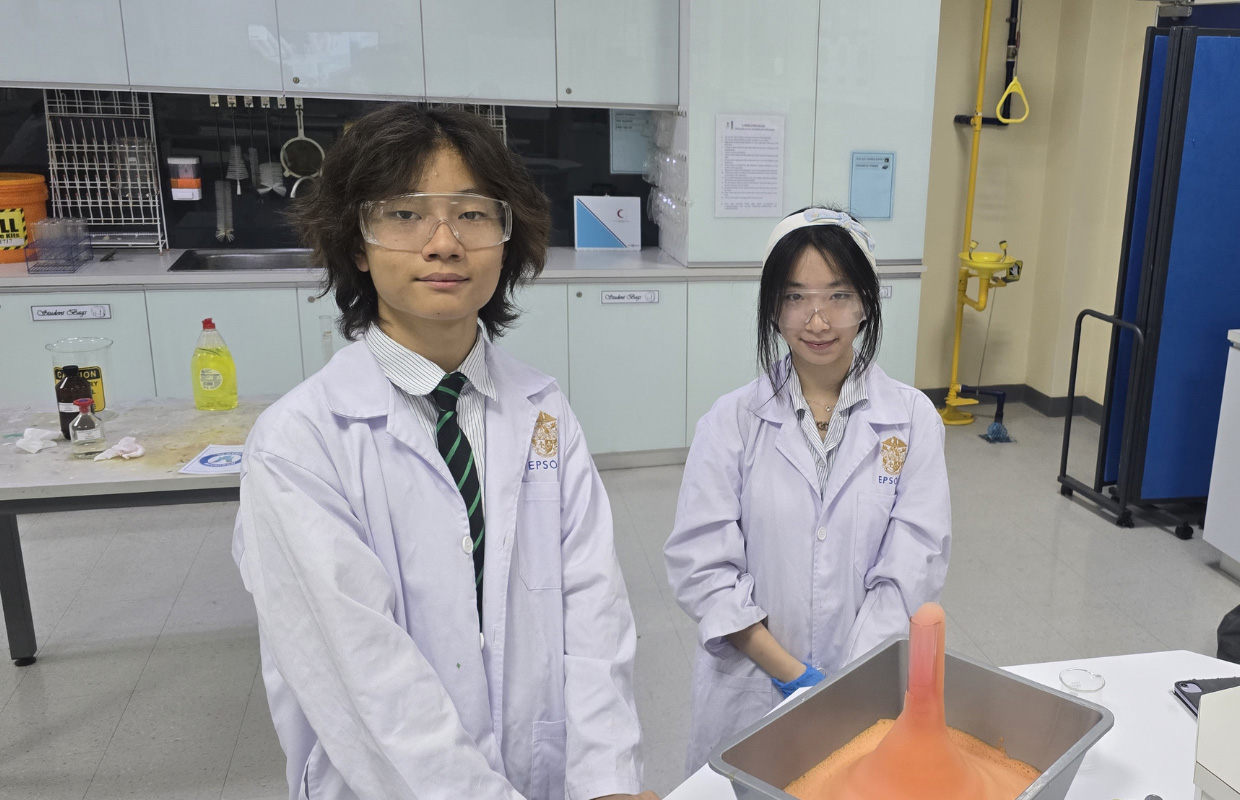
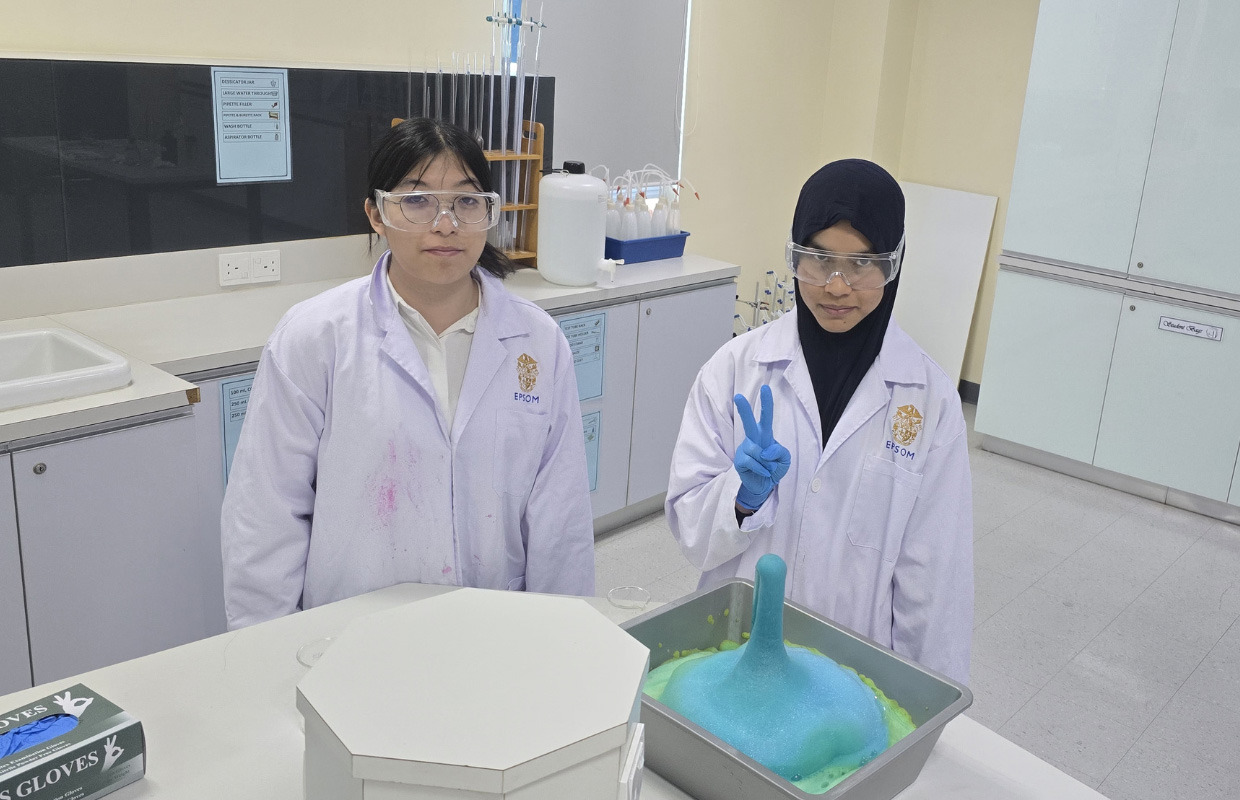
If you walked past the chemistry lab during this week’s Chemistry Society CCA, you likely heard a chorus of gasps, followed by a collective cheer. The source of the excitement? The iconic Elephant’s Toothpaste experiment. It is a staple of science demonstrations, but beneath the towering, steaming foam lies a brilliant display of chemical kinetics and exothermic reactions.
Here is a look at how our members brought this dramatic reaction to life, and the science that makes it happen.
The experiment looks like magic, but it relies on a carefully orchestrated combination of everyday items and laboratory reagents:
- Hydrogen Peroxide: The core ingredient. While household peroxide sits at a mild 3%, the CCA utilised a concentrated 30% solution to ensure a truly monumental reaction.
- Dish Soap: The trap. Without it, the reaction would just produce invisible gas. The soap captures the released oxygen, turning it into thick, durable foam.
- Food Colouring: The artistic touch, striped along the inside of the graduated cylinder to give the resulting foam its classic “toothpaste” appearance.
- Potassium Iodide: The catalyst. This is the spark plug that kicks the whole experiment into overdrive.
The Science Behind the Foam
At its core, the Elephant’s Toothpaste experiment is a demonstration of a decomposition reaction accelerated by a catalyst.
Naturally, hydrogen peroxide slowly breaks down into water and oxygen gas over a long period of time. Left on its own, this process is too slow to notice. However, when the Chemistry Society members added the potassium iodide (KI) solution, the iodide ions acted as a catalyst, dramatically lowering the activation energy required for the reaction to occur.
The chemical equation for this rapid decomposition is:
2H₂O₂ → 2H₂O + O₂
As the potassium iodide was poured in, the H₂O₂ split apart instantly. The resulting oxygen gas (O₂) shot upward through the soapy water and expanded into a massive column of warm, steaming foam that poured over the sides of the cylinder.
More Than Just a Flashy Show
Beyond the visual thrill, the experiment served as a tangible lesson in thermodynamics. Members who reached out to touch the outside of the reaction flask noticed it was distinctly hot. This is because the decomposition of hydrogen peroxide is highly exothermic, meaning it releases a significant amount of heat energy into its surroundings.
Furthermore, the experiment highlighted the defining characteristic of a catalyst: it is not consumed by the reaction. After the foam settled, the iodide ions remained unchanged in the liquid below, ready to be used again.
By taking theoretical concepts from textbooks, like reaction rates, catalysts and enthalpy change, and turning them into a vivid physical reality, the society continues to foster a deeper appreciation for the sciences. We are glad that the participating students truly enjoyed the experiment and learnt a number of concepts in the process.
Mr Mahesh Warrier
Head of Chemistry