
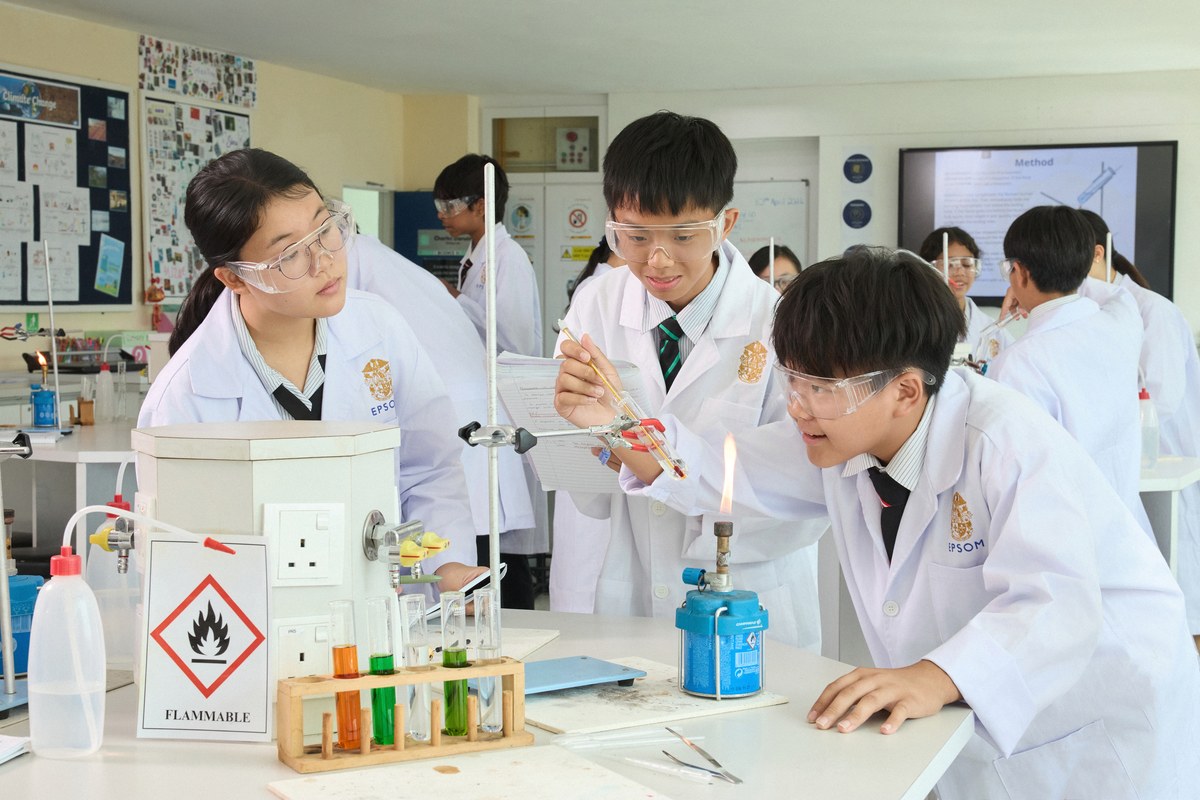
Discovery is often associated with the great scientists of history: those who looked beyond what was already known and asked questions that changed our understanding of the world. But discovery often begins at school, in a classroom, with an experiment such as a titration, a difficult problem involving electric fields, or simply a student’s curiosity. This is perfectly modelled by our students here at Epsom College Malaysia.
Over the past year, our students have demonstrated exactly what it means to discover through science. One example is Dahlia M., who took her interest in chemistry, physics and space far beyond the classroom. She independently coded, researched and developed a theoretical rocket engine that uses HeH⁺ (helium hydride) as a rocket propellant for space travel. To help others understand her work, she even created her own simulator, which you can find here: https://charming-taffy-0dc667.netlify.app/#simulation.
HeH⁺ is thought to have been one of the first molecules to form in the early universe following the Big Bang. By investigating its properties and potential applications, Dahlia was not simply learning existing scientific knowledge; she was using it to explore a question at the frontier of science.
Discovery also requires resilience. Recently, students from Years 11, 12 and 13 challenged themselves by entering a national chemistry competition. Through independent study, problem-solving and a determination to tackle unfamiliar chemistry, our students worked hard to develop their knowledge beyond the confines of the curriculum. Their efforts earned Gold, Silver and Bronze Awards, recognising not only their scientific ability but also their willingness to persevere when faced with challenging problems.
Our Year 13 students are currently exploring some of the biggest questions in modern science. As they learn about the fundamental particles that make up our universe, they are also discovering the remarkable methods scientists use to investigate its origins and properties. From particle accelerators to observations of the cosmos, they see how scientists uncover evidence of events that happened billions of years ago and use it to learn more about the Big Bang.
Discovery is also happening every day in our classrooms and science clubs. Students are encouraged to ask why, test ideas and challenge what they think they know. In our science-inspired CCAs, for example, students have explored how something as simple as the geometry of paper can dramatically change its strength.
These experiences remind us that science is much more than a collection of facts to be memorised. Science is a process of discovery. It is about asking questions, making mistakes, trying again, gathering evidence and using what we learn to ask even better questions.
Whether investigating molecules that existed shortly after the birth of the universe, competing against some of the country’s strongest young chemists, exploring fundamental particles or simply discovering why a folded piece of paper can support more weight, our students are developing something far more valuable than scientific knowledge. They are developing the curiosity, resilience and confidence to become discoverers themselves.
Ms Giovanna Maalouf
Head of Science