
“What is the first thing you should do when you see a person collapsing on the floor?”
The question holds great significance in a real-life scenario that many people are likely to encounter, given that an average worker or university student may have around 6 to 14 meaningful interactions and encounter hundreds of passers-by each day. I am thankful and delighted that, as I write this article, the Aurelius Hospital visit and workshop with Epsom College Malaysia has equipped me with the necessary life-saving steps for these kinds of situations.
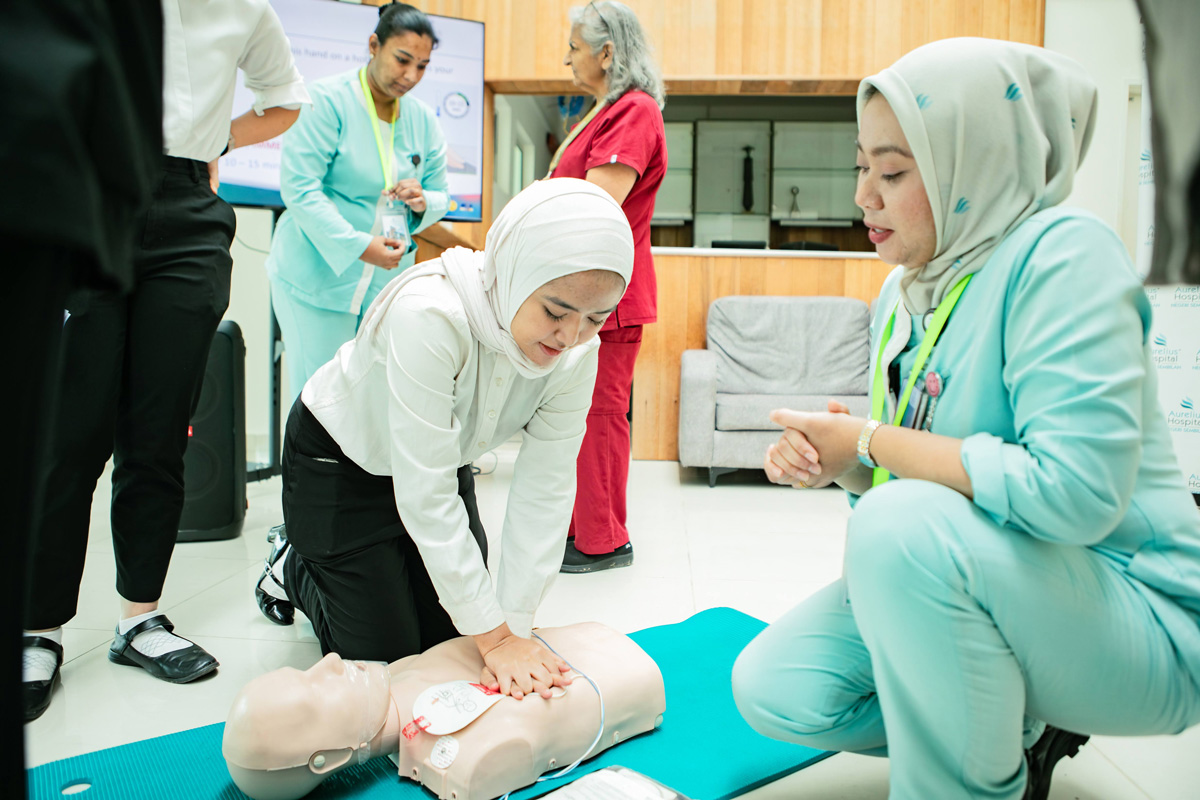
The nurses introduced us to the steps of CPR, which include checking for consciousness by calling the person’s name out loud, calling 999 while asking for an AED, and immediately starting chest compressions. To align with national CPR guidelines, these compressions must be delivered hard and fast in the centre of the chest, at a depth of 2 to 2.4 inches, or 5 to 6 cm, while allowing the chest to fully recoil between each push. Next, they taught and demonstrated the use of an AED, which I think was the highlight of the event. They emphasised the importance of listening carefully to the AED’s voice instructions and properly attaching the pads to the victim’s bare chest.
Following this, the nurses demonstrated what to do when a person is choking. A few students, including Jeonghan L., Gerard T., Sophie M. and Aathityasheshan K., actively participated in the Q&A session and volunteered for both the CPR demonstration and the choking manoeuvre. Students were highly engaged throughout; some were fascinated by the new knowledge they gained, such as learning that the ideal tempo for CPR is 100 to 120 BPM, as well as how to place the victim into the recovery position after they have regained consciousness to ease their respiration. In addition, the nurses also taught us proper bandaging techniques for handling burns.
The session ended with heartfelt thanks and a room full of mixed reactions. Half of us were terrified by the realities we might encounter when living independently in the future, hoping with all our might that we would never face such emergencies. The other half were excited by the new knowledge we had gained, feeling a little more heroic. All in all, I personally applaud the session organised by Mrs Garnett and Mr Garnett, as it was incredibly useful for students like us who will soon venture into independent life beyond school. I hope Epsom continues to organise enriching programmes in PSHE lessons.
Lisa M.
Year 13 Student