
One of the reasons I was drawn to history as a student was the stories. There was something captivating about knowing that even the most outrageous, harrowing or unbelievable events were grounded in reality. They were not imagined, but echoes of something that once was. While this initially drew me in, my studies soon encouraged me to think more deeply: are statistics ever truly inert? Can information be wholly neutral? How does a different lens, or perspective, reshape the narrative?
Teaching History today may look very different from what many of us experienced as students. It is no longer simply about remembering dates or repeating facts. Instead, it is about understanding the nature of information, how it is constructed, how it is used, and why provenance matters when evaluating evidence. In a world of instant information, AI tools and limitless knowledge at our fingertips, an important question emerges: are we using it responsibly? How do we maintain academic integrity in the face of such powerful technological tools? At Epsom College Malaysia, it is this commitment to curiosity, critical thinking and integrity that we aim to foster in every student.
In Term 2, our Year 7 students explored the devastating history of the Black Death through the lens of a medieval village. They were tasked with creating their own historical fiction, grounded in fact, but shaped by empathy and personal perspective. Each student was assigned a role within a feudal society and asked to consider how social position, religious belief and gender influenced experiences of the disease. Their stories varied accordingly: a villein (a peasant tied to the land) had no option to flee, while a noble knight might choose escape, risking the spread of a disease believed to be caused by miasma, or ‘bad air’. In recent years, this topic has taken on even greater resonance. Having lived through the COVID-19 pandemic, students bring a deeper understanding of uncertainty, quarantine and how medical knowledge can transform both treatment and prevention. History is more than simply what happened in the past; it resonates with our modern understanding of the world. It can help us identify patterns, change and continuity, while also gaining a better understanding of motives, actions and outcomes.
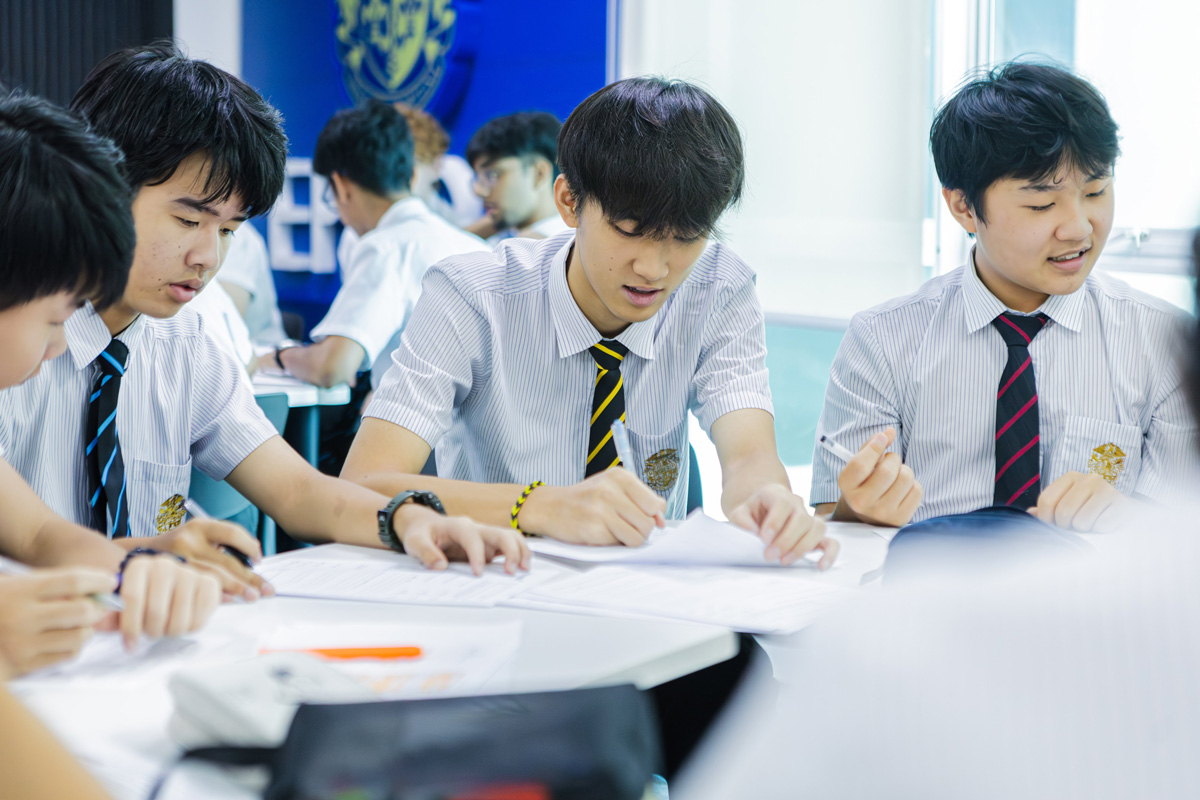
For our IGCSE Year 11 students, Term 1 focused on coursework and the concept of historical significance. Moving beyond the simplistic idea that something was merely ‘important’, students engaged with established frameworks such as the 5Rs and Partington’s criteria to build more nuanced arguments. Their research extended beyond ‘what happened’ to consider scale, impact and legacy. Meanwhile, Year 8 students took up the mantle in Term 2 with a mini coursework-style enquiry, investigating key developments between 1500 and 1750. Whether exploring advances in science and medicine, overseas exploration, or the arts, students examined how innovation, curiosity and critical thinking helped bridge the gap between medieval and industrial societies.
Cross-referencing information, looking for chains of development (cause and consequence), and exploring the value of a source, who created it, what their motives were, and to what extent we can rely on the view being presented, all help our students develop skills that are invaluable when navigating today’s fast-paced, online, data-filled world.
Historians, by nature, can talk endlessly, and there is always more to say than time allows. So, as I bring this to a close, I return to the opening question: is history simply in the past, or does it hold value for today’s world? I would argue that it remains deeply relevant, offering insight, perspective and meaning, even in our fast-paced modern age.
Mrs Chantal Thompson
Head of Humanities